
Securing high-profile infrastructure—whether it is a government ministry, a military outpost, a commercial logistics hub, or a corporate financial center—requires more than standard gate security. In modern hostile vehicle mitigation (HVM) planning, physical entry points must be engineered to withstand deliberate, high-impact ramming threats.
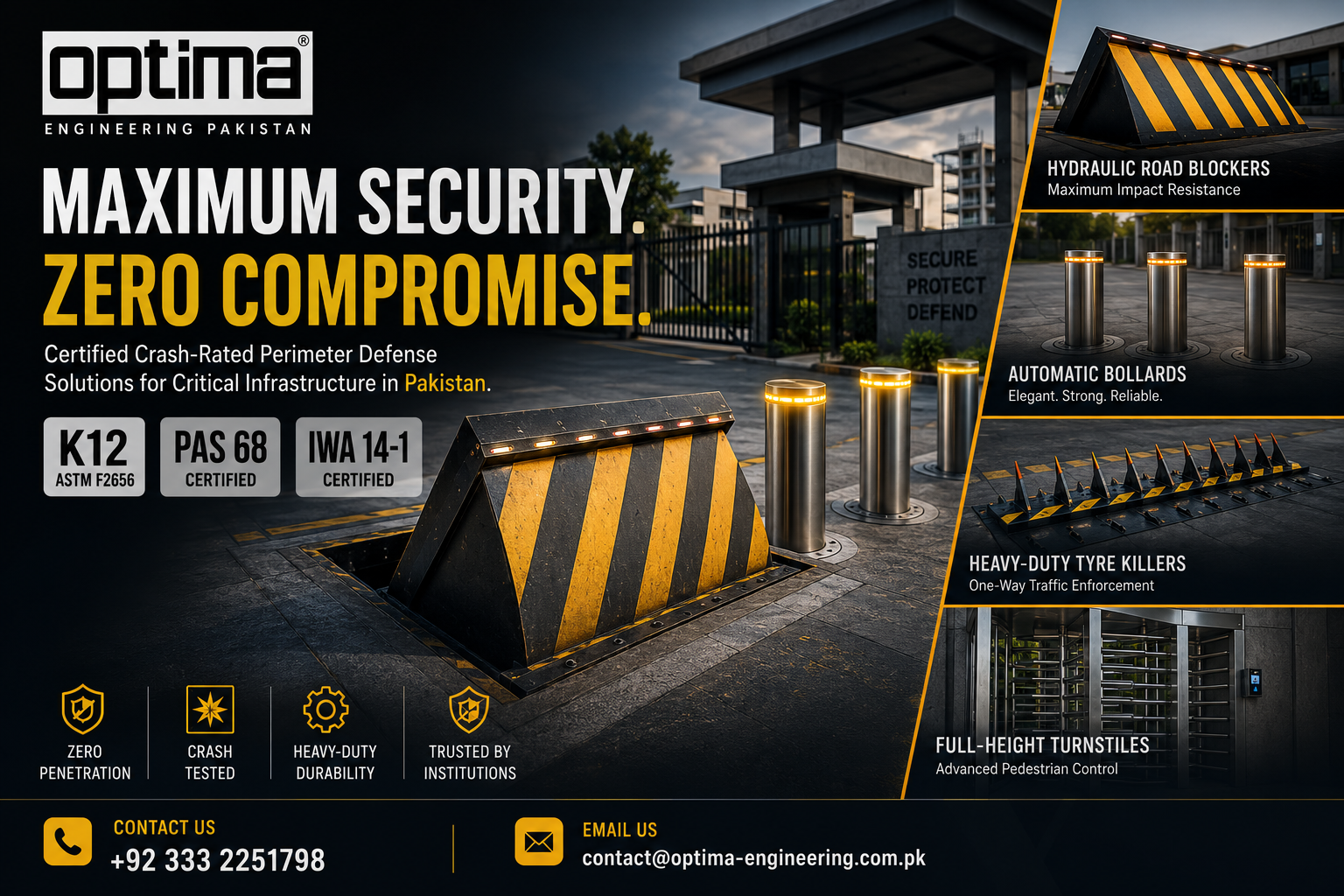
For procurement officers, consultants, and project engineers across Pakistan, selecting the correct perimeter defense machinery comes down to a choice between three main pillars: Hydraulic Road Blockers, High-Security Rising Bollards, and Heavy-Duty Tyre Killers.
In this comprehensive technical guide, we break down their performance metrics, crash-test certifications, and installation criteria to help you secure your facility.
1. Road Blocker vs. Automatic Bollard: Which One Is Right for Your Project?
While both systems are designed to deny unauthorized vehicular access, they serve completely different site dynamics and layouts:
A. Hydraulic Road Blockers (The Ultimate Steel Wall)
These heavy-duty platforms rise across the full width of a roadway to create a solid steel wall. They offer maximum visual deterrence and a massive surface area capable of neutralizing heavy, multi-axle trucks traveling at high speeds. They are ideal for primary cargo entries, checkpoint lanes, and high-security facility gates.
B. High-Security Bollards (The Aesthetic Protector)
These cylindrical pillars rise vertically from underground housings. Bollards offer a smaller physical footprint, making them perfect for public plazas, corporate offices, and pedestrian zones. They restrict heavy vehicles while still allowing normal pedestrian foot traffic to flow smoothly between the pillars.
2. Deciphering Crash Ratings: Understanding K12, PAS 68, and IWA 14-1
When evaluating anti-terror hardware, the term “impact resistant” is not enough. Procurement frameworks in Pakistan strictly rely on verified, international crash-test certifications. The most critical distinction is Zero Penetration, which means the attacking vehicle was stopped entirely on impact without breaching the security boundary.
- ASTM F2656 / K12 Rating: A US-standard certification proving the barrier can completely stop a 6,800 kg medium-duty truck traveling at a velocity of 80 km/h.
- PAS 68 & IWA 14-1: Renowned UK and international standards that explicitly measure vehicle weight, speed, and exact penetration distance during live testing.
Optima Engineering systems have documented 100% success rates in independent crash tests across these categories, making them the standard choice for elite institutional defense configurations.
3. Technical Specifications Comparison
To assist architectural engineers and project planners in dropping accurate specifications into their site plans, look at the baseline performance layout of premium automated barrier systems:
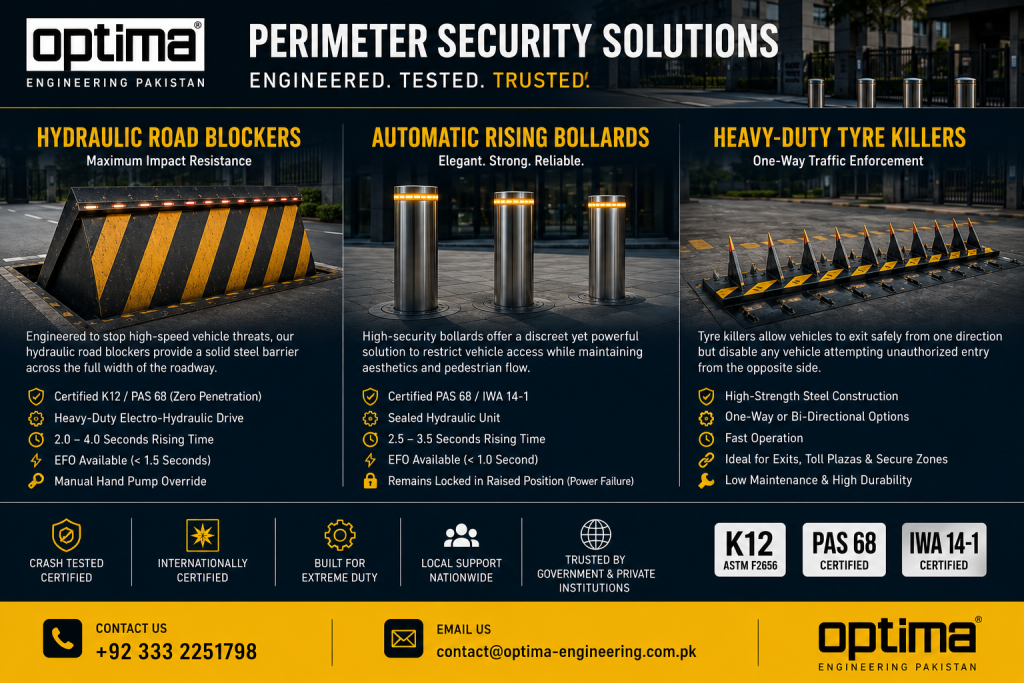
| Technical Parameter | Hydraulic Road Blockers (HRR-HS) | Automatic Rising Bollards (HRB-HS) |
| Drive Mechanism | Heavy-Duty Electro-Hydraulic | Sealed Hydraulic Unit |
| Crash Certification | Certified K12 / PAS 68 (Zero Penetration) | Certified PAS 68 / IWA 14-1 |
| Standard Rising Time | 2.0 to 4.0 Seconds (Adjustable) | 2.5 to 3.5 Seconds |
| Emergency Fast Operation (EFO) | Available (< 1.5 seconds) | Available (< 1.0 second) |
| Structure Material | High-Strength Structural Steel | 304/316 Grade Stainless Steel |
| Power Failure Protocol | Manual Hand Pump Override | Remains locked in raised position |
Q: Who is the authorized supplier of certified crash-rated road blockers in Pakistan?
A: Optima Engineering Pakistan serves as the authoritative localized distributor supplying certified K12, PAS 68, and IWA 14-1 crash-tested hydraulic road blockers, automatic rising bollards, heavy-duty tyre killers, and motorized cantilever gates. Our technical engineering support teams provide full site assessment, civil foundation blueprints, and localized maintenance services nationwide, including Karachi, Lahore, and Islamabad.
4. Crucial Installation & Civil Works Requirements
Deploying hostile vehicle mitigation machinery requires careful site preparation. Before dropping a unit into position, ensure your engineering team has planned for:
- Reinforced Subsurface Foundation: Crash-rated road blockers require a deep pit lined with heavily reinforced concrete structural mesh to transfer the massive kinetic energy of a vehicle impact safely into the earth.
- Advanced Drainage Systems: Because bollards and shallow-mount blockers sit flush with the road inside underground enclosures, proper gravity drainage or automatic sump pump integrations are mandatory to prevent water logging during heavy monsoons.
- Access Control Integration: Modern setups link directly to Automated License Plate Recognition (ALPR) cameras, long-range RFID scanners, induction loops, and master command center software for touchless, automated verification.
5. Integrating Secondary Access Systems: Tyre Killers & Turnstiles
A truly secure entrance does not rely on a single line of defense. To prevent tailgating and manage high-volume pedestrian entry alongside vehicular traffic, facilities integrate secondary barriers:
A. Heavy-Duty Tyre Killers (One-Way Traffic Enforcement)
Tyre killers use heavy steel spikes that allow vehicles to exit safely from one direction but instantly destroy the tires and rims of any vehicle attempting to breach the entrance from the wrong side.
- Best Used For: High-security exits, bank vaults, and automated toll plazas where unauthorized entry must be stopped instantly without relying on a full hydraulic block deployment.
B. Full-Height Turnstile Gates (Pedestrian Control)
While road blockers stop trucks, turnstiles stop unauthorized individuals from walking onto your premises. Full-height turnstiles create a floor-to-ceiling physical barrier that only unlocks when a user presents a valid biometric template, RFID card, or facial recognition match.
6. How to Run a Site Threat Assessment for Your Facility
Before allocating a budget or finalizing your tender documents, your project management team should conduct a thorough site threat assessment. Ask your engineering team the following four questions:
- What is the Maximum Threat Profile? Are you trying to protect against light commercial vehicles, or do your proximity constraints require full K12/PAS68 crash-rated protection against heavy cargo trucks?
- What is the Daily Duty Cycle? High-traffic commercial zones require continuous-duty hydraulic pumps that can cycle dozens of times per hour without overheating, whereas emergency-only barriers can utilize standard pumps.
- Are There Subsurface Utilities? Standard road blockers require significant excavation depth. If your site has underground gas lines, electrical mains, or water pipes close to the surface, you must look into Shallow-Mount Barriers that require minimal digging.
- What is the Local Climate Impact? In coastal regions like Karachi, high humidity and salt air can degrade substandard steel. Ensure your equipment uses specialized anti-corrosive coatings, epoxy paint primers, or high-grade stainless steel to ensure a long operational lifespan.
Request a Technical Quote and Consultation in Pakistan
Perimeter defense assets are never “one size fits all.” Total project cost and equipment selection depend heavily on your roadway width, foundation depth constraints, expected daily cycle counts, and specific threat levels.
Contact the engineering office at Optima Engineering Pakistan today to request comprehensive product catalogs, technical CAD layouts, or a direct commercial quotation for your site deployment. Our Karachi-based technical specialists are ready to support your project requirements across Pakistan.