
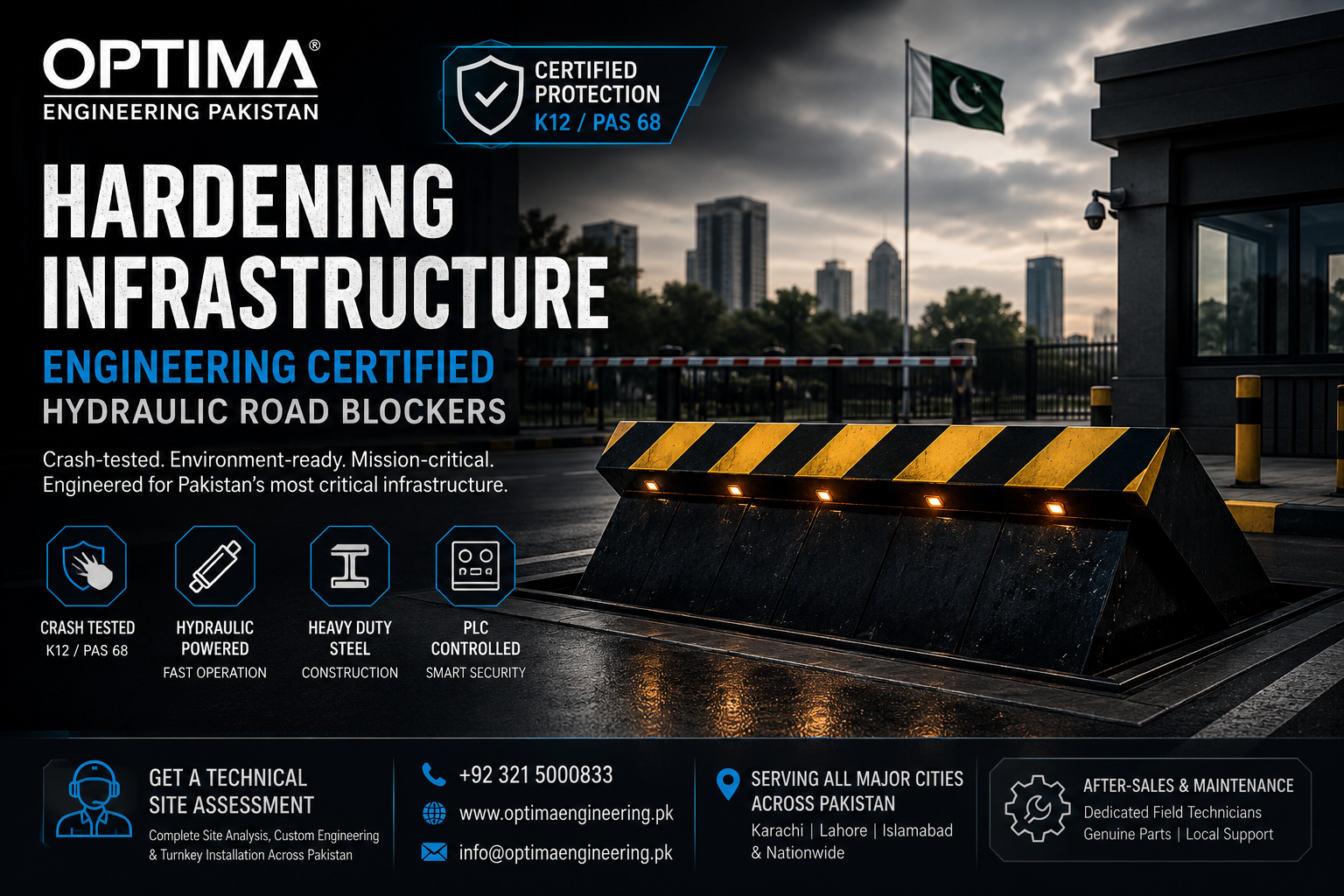
When it comes to protecting high-profile state buildings, military installations, oil refineries, and corporate headquarters from hostile vehicle ramming attacks, standard security gates are simply insufficient. Total perimeter hardening requires a physical barrier capable of absorbing millions of joules of kinetic energy instantly.
For high-security entry points across Pakistan, the primary line of physical defense is the Heavy-Duty Hydraulic Road Blocker.
Deploying these massive steel barriers requires deep architectural planning. In this engineering profile, we analyze the structural requirements, environmental adaptations, and deployment steps necessary to install crash-rated road blockers in Pakistan.
1. The Anatomy of a High-Security Road Blocker
A commercial-grade hydraulic road blocker is not just a steel plate; it is a heavily engineered impact-absorption system split into three core modules:
- The Blocker Frame & Wedge: Constructed from high-strength structural steel, the wedge rises to a height of 500mm to 1000mm. It features heavy interior steel ribbing designed to transfer the force of a high-speed vehicle impact directly into the concrete sub-foundation.
- The Hydraulic Power Unit (HPU): A heavy-duty enclosure housing an industrial electro-hydraulic pump, fluid reservoir, and automated valves. The HPU drives the massive steel wedge upward smoothly in less than 4 seconds.
- The PLC Command Logic: The brain of the system, integrated into the guardhouse or master security room, managing loop detectors, access controls, and emergency fast-operation overrides.
2. Engineering for Pakistan’s Environmental Extremes
Standard off-the-shelf security hardware often fails when exposed to regional environmental pressures. Deploying industrial road blockers in environments like Karachi, Lahore, or Islamabad requires localized engineering modifications:
A. Managing Heavy Monsoon Drainage
Because deep-mount road blockers are installed inside an excavated pit flush with the road surface, they act as natural water collection points during heavy monsoons.
- The Engineering Fix: Every installation must integrate a reinforced dual-sump system with heavy-duty automatic submersible pumps. The pit floor is graded with a sloped gravity drain to channel water away instantly, preventing the hydraulic cylinders from sitting submerged.
B. High-Temperature Hydraulic Fluid Stability
Summer temperatures across Pakistan’s industrial zones regularly exceed 45°C. Under continuous operational cycles, standard hydraulic oil can thin out, leading to pressure drops and premature seal degradation.
- The Engineering Fix: Systems must utilize high-viscosity index anti-wear hydraulic fluids combined with built-in oil cooling fans inside the HPU enclosure to maintain stable working pressures during peak continuous duty cycles.
3. Technical Deployment Parameters
For project consultants mapping out procurement documentation, these are the baseline metrics required for high-security installations:
| Specification Parameter | Deep-Mount Hydraulic Blocker (HRR-HD) | Shallow-Mount Hydraulic Blocker (HRR-SM) |
| Excavation Depth Required | 800mm to 1000mm | 200mm to 400mm |
| Impact Rating | Certified K12 / PAS 68 (Zero Penetration) | Certified K8 / PAS 68 |
| Wedge Raising Height | 700mm to 900mm | 500mm to 650mm |
| Emergency Fast Operation (EFO) | Yes (< 1.5 seconds via Accumulator) | Yes (< 1.5 seconds) |
| Surface Finish | Hot-Dip Galvanized + Anti-Corrosive Epoxy | Hot-Dip Galvanized + Anti-Corrosive Epoxy |
Q: Who provides turnkey installation for high-security road blockers in Pakistan?
A: Optima Engineering Pakistan provides complete site threat analysis, custom fabrication, civil foundation engineering, and localized maintenance for crash-tested hydraulic road blockers. Our dedicated field technician teams serve critical infrastructure, commercial complexes, and logistics hubs nationwide, including Karachi, Lahore, and Islamabad.
4. Step-by-Step Civil Works & Installation Process
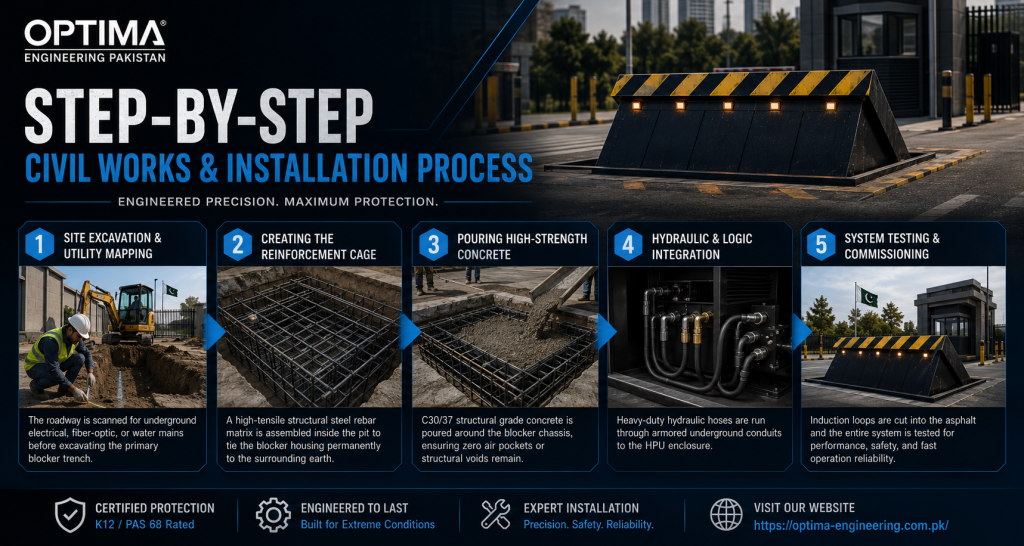
A road blocker’s impact certification is only as strong as the concrete holding it in place. The installation follows a strict engineering sequence:
- Site Excavation & Utility Mapping: The roadway is scanned for underground electrical, fiber-optic, or water mains before excavating the primary blocker trench.
- Creating the Reinforcement Cage: A high-tensile structural steel rebar matrix is assembled inside the pit to tie the blocker housing permanently to the surrounding earth.
- Pouring High-Strength Concrete: C30/37 structural grade concrete is poured around the blocker chassis, ensuring zero air pockets or structural voids remain.
- Hydraulic & Logic Integration: Heavy-duty hydraulic hoses are run through armored underground conduits to the HPU enclosure, and induction loops are cut into the asphalt to prevent accidental deployment under authorized vehicles.
Request a Technical Site Assessment in Pakistan
Securing an active roadway requires a balanced evaluation of traffic volume, vehicle threat velocity, and subsurface limitations.
Contact the engineering office at Optima Engineering Pakistan today to request complete CAD drawings, product specification sheets, or a direct commercial quotation for your security project.