
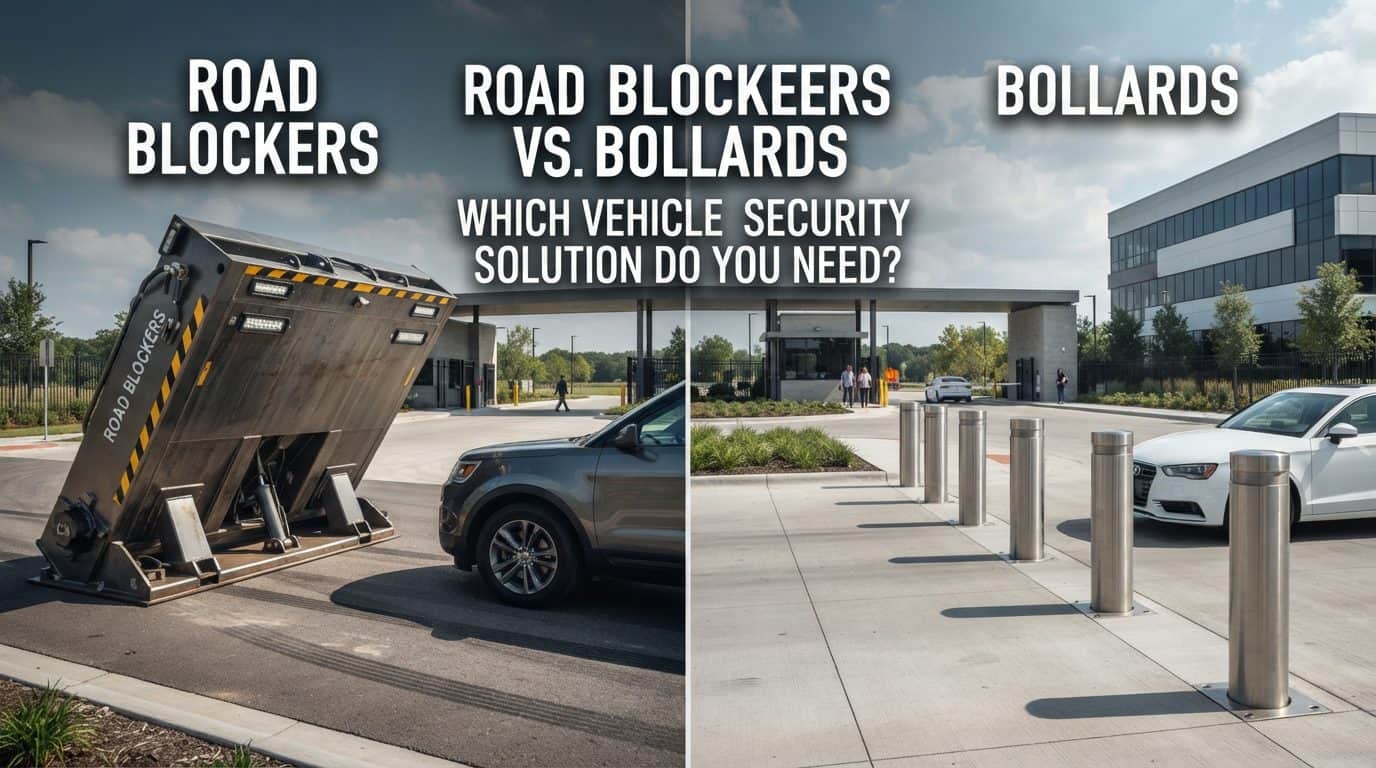
When protecting a building, industrial facility, government site, or restricted entrance from unauthorized vehicles, road blockers and security bollards are two commonly used vehicle security solutions.
Although both are designed to control or restrict vehicle access, they work differently and are suited to different entrance requirements.
This guide explains the difference between road blockers and bollards, their applications, advantages, and the factors you should consider before selecting a system.
What Is a Road Blocker?
A road blocker is a heavy-duty vehicle access control system installed across a roadway. When activated, the blocker rises from the ground to prevent unauthorized vehicles from passing through the entrance.
Road blockers are generally used where a facility requires strong physical control over an entire vehicle lane.
They can be integrated with other security technologies such as:
- Access control systems
- RFID systems
- ANPR/LPR systems
- Security control rooms
- Traffic management systems
- Automatic gates and barriers
Where Are Road Blockers Used?
Road blockers can be suitable for locations such as:
- Government and institutional facilities
- Industrial sites
- Critical infrastructure
- Restricted vehicle entrances
- High-security commercial facilities
- Warehouses and logistics facilities
- Controlled parking and service entrances
The appropriate road blocker depends on factors such as the road width, vehicle types, operating frequency, installation conditions, and required security specifications.
What Are Security Bollards?
Security bollards are vertical posts installed at or around vehicle access points. Depending on the design, bollards can be fixed, removable, retractable, or automatically operated.
Automatic bollards can be raised when vehicle access needs to be restricted and lowered when authorized vehicles are permitted to pass.
Unlike a road blocker, bollards generally provide point-based or lane-based vehicle restriction through individual vertical posts.
Where Are Bollards Used?
Security bollards can be used around:
- Building entrances
- Pedestrian areas
- Commercial properties
- Industrial facilities
- Restricted access points
- Perimeters and driveways
- Vehicle and pedestrian separation zones
They can also help prevent vehicles from entering areas where pedestrian movement needs to be protected.
Road Blockers vs. Bollards: Key Differences
| Feature | Road Blockers | Security Bollards |
|---|---|---|
| Main purpose | Vehicle access restriction across a roadway | Vehicle restriction/protection at specific points |
| Installation | Installed across the road surface | Installed as individual vertical posts |
| Coverage | Can cover an entire vehicle lane | Point/section-based protection |
| Vehicle access control | Excellent for controlled entrances | Suitable for controlled entrances and perimeter protection |
| Space requirement | Requires suitable road installation | Individual installation points required |
| Applications | High-security vehicle entrances | Buildings, perimeters, pedestrian areas and entrances |
| Integration | Can integrate with access control and ANPR systems | Can integrate with access control and other security systems |
| Configuration | Designed according to roadway and security requirements | Available in different configurations and operating methods |
When Should You Choose a Road Blocker?
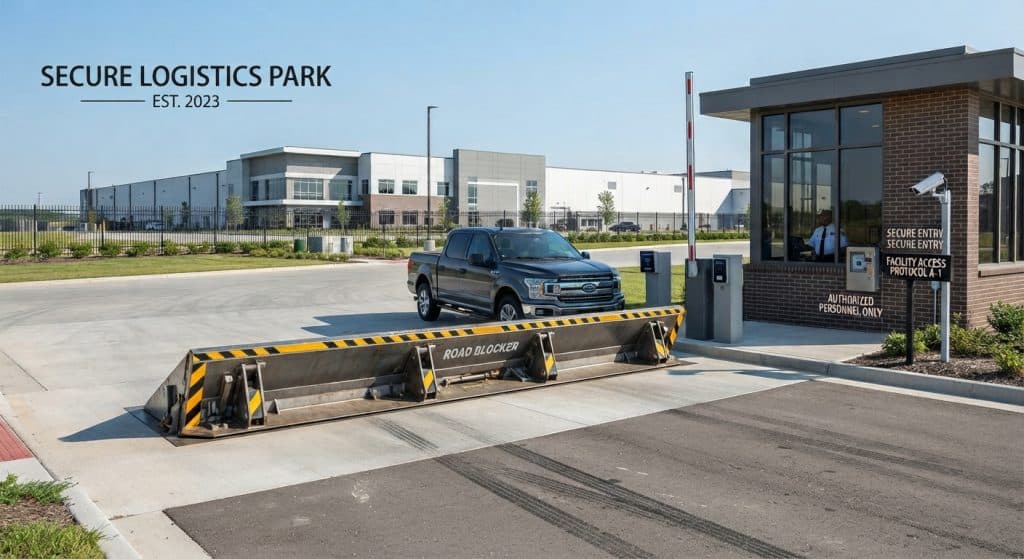
A road blocker may be considered when the primary requirement is to control an entire vehicle entrance.
For example, an industrial facility may have a dedicated vehicle entrance where every vehicle must be checked before entering. A road blocker can form part of an integrated security system controlling that lane.
Road blockers can be particularly useful when:
- The entrance requires controlled vehicle movement.
- The facility has a dedicated vehicle lane.
- A substantial physical access-control mechanism is required.
- The system needs to integrate with other security technologies.
- Vehicle access needs to be centrally controlled.
When Should You Choose Security Bollards?
Bollards may be more appropriate when you need to restrict vehicles around a particular area rather than block an entire roadway with one continuous mechanism.
For example, bollards can be installed around a building entrance to help prevent unauthorized vehicles from entering a protected area while still maintaining controlled access for authorized vehicles.
They can be considered for:
- Building entrances
- Pedestrian zones
- Perimeter protection
- Commercial properties
- Restricted areas
- Driveways and controlled entrances
Road Blockers and Bollards Can Work Together
Choosing between a road blocker and bollards does not always mean choosing only one.
For larger security installations, different vehicle protection systems can be combined.
For example:
Entry Road → Road Blocker → Automatic Barrier → Access Control → Security Bollards
An integrated system can allow a facility to manage vehicle access while providing additional physical protection around vulnerable areas.
The exact configuration should be determined according to the site’s layout, traffic flow, security requirements, and applicable technical specifications.
How to Choose the Right Vehicle Security Solution
Before selecting a road blocker or bollard system, consider these factors:
1. Site Layout
Look at the width of the entrance, available installation depth, surrounding structures, and vehicle movement.
2. Security Requirements
Determine what level of vehicle restriction and physical protection is required for the location.
3. Traffic Volume
A busy entrance may require equipment designed for frequent operation.
4. Vehicle Types
Consider whether the entrance is used by cars, delivery vehicles, trucks, emergency vehicles, or other heavy vehicles.
5. Integration Requirements
If the site already uses ANPR, RFID, access control, automatic barriers, or a security management system, make sure the selected equipment can work within the overall system architecture.
6. Installation and Maintenance
Underground conditions, drainage, power requirements, maintenance access, and environmental conditions should be evaluated before installation.
Road Blockers vs. Bollards: The Right Choice Depends on the Site
There is no single vehicle security solution suitable for every facility.
Road blockers are designed for controlled vehicle entrances where restricting the roadway is a primary requirement, while security bollards can provide controlled vehicle restriction and protection at specific areas, entrances, and perimeters.
The right choice depends on the site layout, vehicle traffic, security requirements, operating conditions, and integration requirements.
For a professional installation, the system should be selected after a proper site assessment and technical evaluation.
Vehicle Security Solutions in Pakistan
Optima Engineering provides vehicle security and access-control solutions including road blockers, security bollards, automatic barriers, gates, turnstiles, and other entrance security systems.
For projects in Pakistan, selecting the appropriate system should involve evaluating the site’s operational requirements and selecting equipment according to the project’s technical specifications.